
Apple trees, pear trees, plum trees, and cherry trees are common in Boise’s residential neighborhoods and throughout the Treasure Valley. Many homeowners planted them intentionally; others inherited them with their property. Whatever the reason they are present, fruit trees have a consistent and well-documented relationship with yellowjacket activity in late summer—and understanding that relationship helps Boise homeowners manage both their trees and their pest problems more effectively.
Wild West Pest Control handles stinging insect control throughout Boise and the surrounding Treasure Valley. Our wasp control service addresses yellowjacket nests and activity for homeowners dealing with the pest conditions that fruit trees contribute to.
Why Fallen Fruit Is a Yellowjacket Magnet
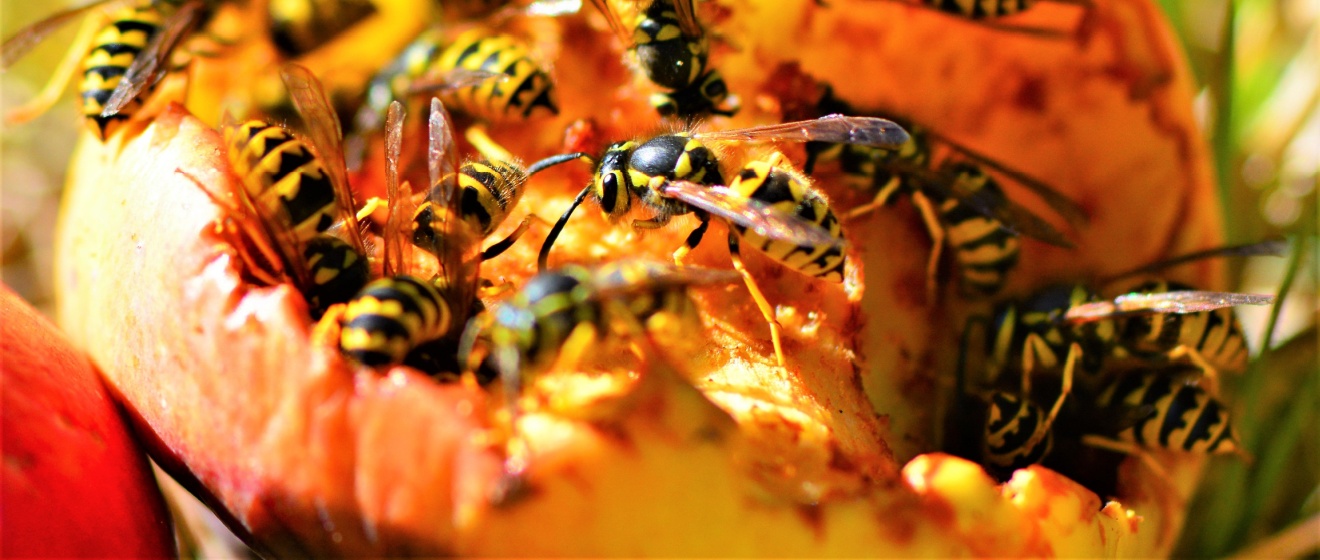
Yellowjacket colonies feed their larvae on protein—insects, spiders, and other arthropods—but adult yellowjackets require carbohydrates for their own energy, and they obtain those carbohydrates from sugary materials including plant sap, nectar, and fruit. As the summer progresses and natural nectar sources diminish in Boise’s hot, dry climate, yellowjackets increasingly shift their foraging focus toward the most concentrated and accessible sugar sources available. Ripe and overripe fruit is among the most reliable of those sources.
Fallen fruit on the ground beneath a tree is particularly attractive because it is accessible and concentrated. A single fallen apple that has been sitting on the ground for a day begins to ferment as its sugars break down, releasing compounds that are highly attractive to yellowjackets and other wasps from a significant distance. In late July and August, when yellowjacket colonies in the Treasure Valley are reaching peak size and foraging activity is at its most intense, a fruit tree with dropped fruit beneath it can draw yellowjackets from nests located well beyond the immediate property.
The Timing Problem
The relationship between fruit trees and yellowjacket activity is particularly pronounced in Boise because the timing of fruit drop coincides with the peak of the yellowjacket season. Most backyard fruit trees in the Treasure Valley drop their heaviest fruit loads in July, August, and September—exactly the period when yellowjacket colonies are at their largest and most aggressive.
Earlier in the summer, when fruit is still on the tree and colonies are smaller, the relationship is less significant. But by the time the first significant fruit drop occurs in July, the yellowjacket colonies nearby have been building for three months and can contain thousands of workers. Those workers are actively seeking high-energy food sources, and a yard with ripe fruit dropping consistently is providing exactly what they need.
Which Fruit Trees Are Most Problematic
Not all fruit trees attract the same level of yellowjacket activity. Several factors affect how strongly a tree draws wasps.
Fruit sugar content. Higher-sugar fruits ferment more rapidly and produce more of the volatile compounds that attract yellowjackets at a distance. Apples and pears, which are among the highest-sugar tree fruits common in Boise gardens, tend to attract more yellowjacket activity than lower-sugar fruits.
Drop volume and timing. Trees that drop large quantities of fruit in a concentrated period—creating a persistent accumulation on the ground—attract more sustained activity than trees that drop fruit gradually. An apple tree that drops most of its fruit in a two-week window in August creates a more significant yellowjacket attractant than one whose fruit drops and is collected over a longer period.
Ground conditions under the tree. Fruit that falls onto hard surfaces—concrete, pavers, and compacted soil—is more accessible to yellowjackets and ferments more visibly than fruit that falls into tall grass or ground cover where it is partially concealed. Open ground under a tree concentrates yellowjacket activity in a defined, visible area.
Proximity to nests. A fruit tree on a property with an active yellowjacket nest nearby will see more activity than the same tree on a property without nests. The relationship between fruit trees and yellowjackets is most intense when both a nest and a food source are present on or near the same property.
The Relationship Between Fruit Trees and Wasp Nesting
Fruit trees do not just attract foraging yellowjackets—they also create conditions that make a property more likely to host yellowjacket nests. The root zones of established fruit trees provide loose, partially shaded soil that is attractive for ground nesting. The tree canopy provides shade that moderates soil temperature around potential nest sites. And the reliable food source that fruit provides from year to year makes a property consistently attractive to yellowjackets throughout the season.
Properties with multiple established fruit trees in Boise tend to have higher yellowjacket nest density in their yards than properties without fruit trees, not only because of the food source but also because the overall property conditions are more favorable for nest establishment and colony survival.
What Boise Homeowners With Fruit Trees Can Do
Managing yellowjacket activity around fruit trees requires addressing the food source, the nest conditions, and the existing population simultaneously.
Collect fallen fruit promptly. The most effective single step is removing fallen fruit from the ground as quickly as possible—ideally within 24 hours of drop. Fruit that is collected before it begins to ferment produces minimal yellowjacket attraction. During peak drop periods, this may mean collecting fruit every day or two. The effort is significant during heavy drop periods but produces a noticeable reduction in yellowjacket activity around the tree.
Use mesh bags or tarps. Placing temporary tarps or mesh under a tree during peak fruit drop allows fallen fruit to be collected quickly without the need to pick through ground cover or grass. Some homeowners find this approach more manageable than searching for individual fallen fruit daily.
Inspect for ground nests in the root zone. The area beneath and around a fruit tree should be inspected in late spring and early summer for signs of yellowjacket ground nesting—small soil holes with workers entering and exiting. Addressing a nest in May or June, before it has grown through the summer, is far more manageable than treating the same nest in August.
Professional perimeter treatment. Wild West Pest Control’s bi-monthly service plan includes cobweb and wasp nest removal as a standard component. Properties on a recurring service schedule have yellowjacket nests and activity addressed before they reach the late-summer levels that make them most hazardous. For properties with significant fruit tree activity and no current service plan, contact us for a free quote to assess the specific conditions on your property and get a treatment plan in place before peak yellowjacket season arrives.