
Boise’s high desert climate, proximity to the Boise River corridor, and mix of irrigated residential landscaping and open natural land support a consistent and diverse stinging insect population from spring through fall. Several species are common in Treasure Valley backyards, and each one has distinct behavior, nesting habits, and risk profile. Knowing which species you are dealing with is the starting point for managing them effectively.
Wild West Pest Control handles stinging insect removal throughout Boise and the surrounding area. Our wasp control service covers the species described below, and the information here reflects what our technicians encounter most frequently on Treasure Valley properties.
Yellowjackets
Yellowjackets are the stinging insect that generates the most pest control calls in Boise each summer, and they are the species most responsible for the serious stinging incidents that send people to urgent care. Several species of yellowjacket are present in Idaho, with the western yellowjacket (Vespula pensylvanica) being the most commonly encountered in Treasure Valley residential areas.
Yellowjackets are social wasps that live in large colonies. A single colony founded by one queen in April can grow to contain several thousand workers by late summer. They are aggressive defenders of their nest and will respond forcefully to disturbances—including vibrations from lawn equipment, footsteps near a ground nest, and any perceived threat within several feet of the nest entrance.
Yellowjackets nest in the ground, in wall voids, and in any protected cavity—under decks, inside hollow logs, and within the cavities of block walls. Ground nests are the most common and most hazardous in Boise backyards. The nest entrance is a small hole in the soil, often inconspicuous until workers are observed entering and exiting. Ground nests are most commonly discovered by homeowners during mowing, gardening, or any activity that brings them close to the nest—at which point the colony’s defensive response can be rapid and severe.
Paper Wasps
Paper wasps are the most visible stinging insect in Boise backyards, largely because their nests are built in exposed locations—under eaves, in door frames, inside porch light fixtures, on fence rails, and in any sheltered exterior surface. Their nests are open and umbrella-shaped, with visible hexagonal cells, and are constructed from chewed wood fiber that dries to a papery gray material.
Several paper wasp species are present in the Treasure Valley, including the western paper wasp (Mischocyttarus flavitarsis) and the yellow paper wasp (Polistes aurifer). Paper wasps are less aggressive than yellowjackets under most conditions—they will tolerate human activity nearby without reacting unless the nest itself is approached directly or disturbed. A paper wasp nest under an eave near a frequently used entry door, however, becomes a hazard as the season progresses and the colony grows.
Paper wasp colonies are smaller than yellowjacket colonies—typically between 20 and 100 workers at peak—which makes them less dangerous when encountered but also means there are more of them across a property. A single home in Boise can have multiple active paper wasp nests in different locations simultaneously.
Bald-Faced Hornets
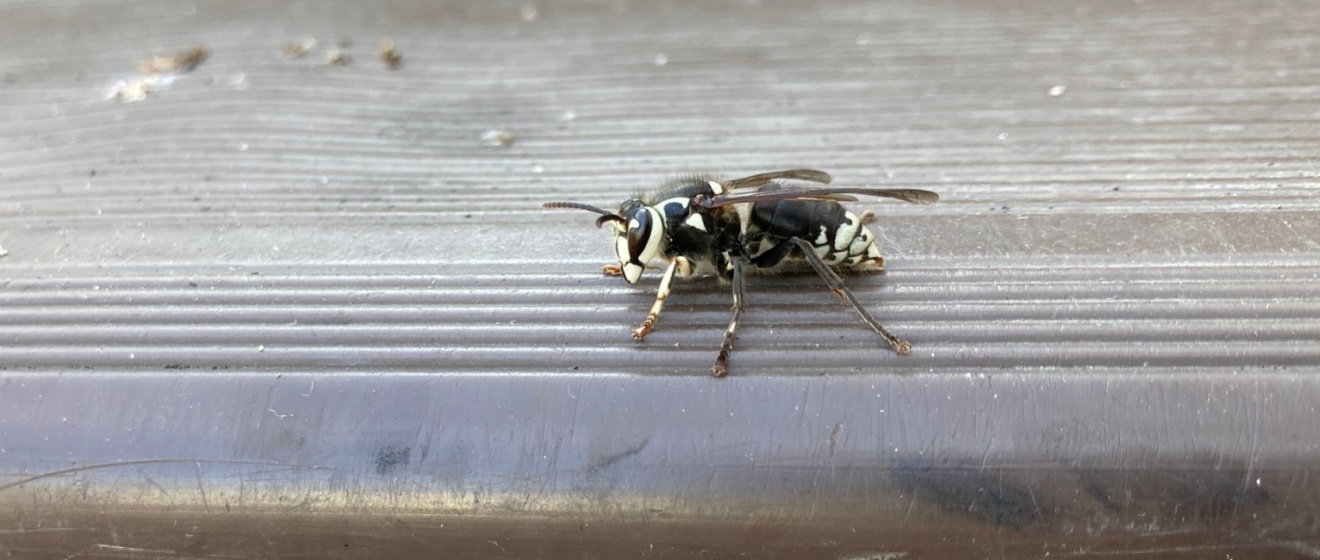
Bald-faced hornets (Dolichovespula maculata) are a large, distinctively marked species—black with white facial markings—that builds enclosed, football-shaped paper nests typically suspended from tree branches, eaves, and utility structures. Their nests are unmistakable once they reach full size in late summer, sometimes growing as large as a basketball.
Bald-faced hornets are aggressive defenders of their nest and have a larger defensive perimeter than paper wasps—any disturbance within several feet of the nest can trigger a response. Unlike bees, wasps, including bald-faced hornets, can sting repeatedly without losing their stinger, and multiple workers will respond to a perceived threat simultaneously. Encountering a mature bald-faced hornet nest unexpectedly—while pruning trees, cleaning gutters, or working on the exterior of the home—is one of the more hazardous stinging insect situations a Boise homeowner can face.
Bald-faced hornet nests in Boise are most commonly found in deciduous trees and tall shrubs, under roof overhangs, and attached to exterior structural elements. They are more common on properties with mature tree cover than on properties with minimal vegetation.
Mud Daubers
Mud daubers are solitary wasps—they do not live in colonies and are not aggressive. Female mud daubers build small, tubular nests from wet mud on exterior walls, under overhangs, in garages, and on any sheltered surface. The most common species in the Treasure Valley are the black and yellow mud dauber (Sceliphron caementarium) and the blue mud dauber (Chalybion californicum).
Mud daubers provision their nests with spiders—they paralyze spiders, place them in the mud tubes as food for larvae, and seal the tube. They rarely sting even when handled directly and pose virtually no defensive risk. Their nests accumulate on structures over time, which homeowners find objectionable, but mud daubers themselves are not a safety concern.
Bees: Honey Bees and Bumble Bees
Honey bees and bumble bees are not wasps, but they are common stinging insects in Boise backyards that homeowners regularly misidentify as yellowjackets or paper wasps.
Bumble bees nest in the ground or in low-lying cavities—abandoned rodent burrows, under dense ground cover, and in compost piles. They are less aggressive than yellowjackets but will sting in defense of the nest. Bumble bees are important pollinators and are best left alone unless a nest is located in a high-traffic area where stings are likely.
When to Call a Professional
Any stinging insect nest located near a frequently used entry point, outdoor living area, or play space warrants professional treatment regardless of species. For individuals with venom allergies, any nest on the property is a risk that should be addressed promptly. Wild West Pest Control provides stinging insect removal throughout Boise and the Treasure Valley. Contact us for a free quote to have nests assessed and treated safely.