

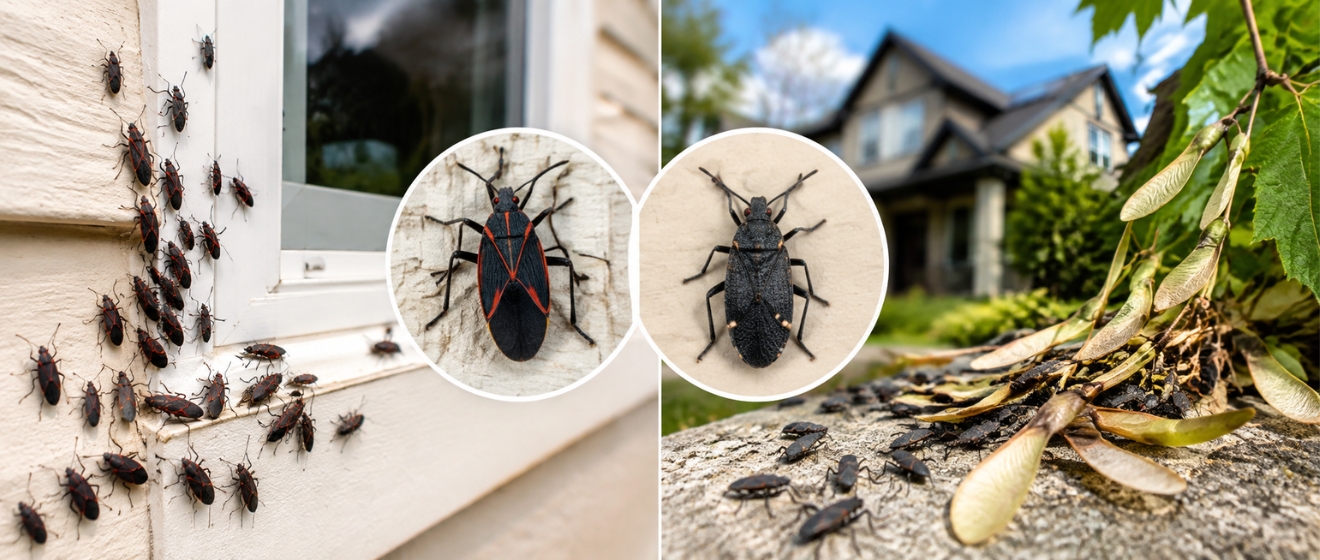
When tiny black bugs begin covering windows, siding, doors, and patios, Boise homeowners often assume they are all the same pest. In the Treasure Valley, two common suspects are boxelder bugs and elm seed bugs. Both gather on buildings, slip through small gaps, and may appear indoors long after the outdoor activity seems to stop. Correct identification matters because their habits are different, even when the homeowner’s first impression is simply, “There are bugs everywhere.” Wild West Pest Control’s boxelder bug control service helps Boise-area homeowners identify the invader and choose the right response.
Start With the Color and Markings
Adult boxelder bugs are dark brown or black with distinct reddish-orange lines along the wings and behind the head. Their bodies are long and somewhat flattened, and adults are usually close to half an inch long. Younger boxelder bugs, called nymphs, are much brighter red and develop darker markings as they mature.
Elm seed bugs are smaller and less dramatic in appearance. They are generally brown, gray-brown, or nearly black, with a mottled pattern that can be difficult to see without looking closely. Their bodies are shaped somewhat like a narrow oval. From a few feet away, a large group of elm seed bugs may look like a scattering of tiny black dots.
If the insects have obvious red lines, boxelder bugs are the stronger possibility. If they are smaller, duller, and accompanied by a noticeable odor when crushed, elm seed bugs may be responsible.
Why These Bugs Gather on Boise Homes
Both pests use buildings as shelter when outdoor conditions begin to change. Warm, sunlit siding gives them a place to gather before they search for protected cracks and voids. South- and west-facing walls often receive the most activity because they hold warmth later in the day.
Boxelder bugs are associated with boxelder trees and other seed-bearing maples. They feed primarily on developing seeds, leaves, and plant material outdoors. Elm seed bugs develop around elm trees and feed on elm seeds. Mature trees in established Boise neighborhoods can support large numbers of either pest, but the presence of the tree does not necessarily mean it should be removed. The insects can travel from nearby properties, street trees, and green spaces.
What Happens After They Get Inside?
These insects do not usually reproduce throughout the home or feed on furniture, clothing, wood, or stored food. Their goal is shelter. They enter around window frames, utility penetrations, attic vents, siding gaps, soffits, and doors. Once hidden inside wall voids or attics, they may remain quiet for weeks or months.
Indoor heat can wake them during fall and winter. A homeowner may then find bugs crawling near sunny windows, lamps, or upper-story rooms. That does not always indicate a new invasion. Some of the insects may have entered earlier and are emerging from their hiding places.
Boxelder bugs and elm seed bugs are primarily nuisance pests, but a large indoor population is still frustrating. Boxelder bugs can leave stains when crushed. Elm seed bugs may release a strong odor. Vacuuming visible bugs is usually cleaner than smashing or spraying them on finished indoor surfaces. The vacuum contents should be emptied into a sealed bag outside.
Why Spraying the Bugs You See May Not Solve It
A pile of dead bugs on a windowsill does not address the insects concealed behind siding, trim, or insulation. Indoor aerosol sprays can scatter insects into other areas and may leave residues where they are not needed. They also do little to close the paths that new bugs use.
Timing is important. Exterior treatment is generally most useful before or during the period when insects are gathering on the building. A professional can focus attention on likely resting areas and entry zones while also checking whether the pest has been identified correctly. Once a large population is already sealed inside walls, the plan may shift toward removal of visible insects, monitoring, and exclusion work at an appropriate time.
How Boise Homeowners Can Reduce Future Activity
Inspect the exterior before cool weather becomes established. Replace damaged door sweeps and weatherstripping. Repair loose screens, seal gaps around pipes and cables, and check transitions where siding meets trim. Attic and crawl-space vents should remain functional, so openings should be protected with suitable screening instead of being blocked completely.
Homeowners can also clear leaves, seed debris, and clutter from the foundation. These steps will not eliminate insects developing in neighborhood trees, but they can reduce sheltered areas immediately beside the house. Heavy activity often requires a combination of well-timed exterior service and practical repairs.
When hundreds of tiny black bugs appear, guessing from a distant photo can lead to the wrong plan. Wild West Pest Control understands the seasonal pest patterns found in Boise, Meridian, Eagle, Nampa, and nearby Treasure Valley communities. Contact Wild West Pest Control for help identifying the insects and building a targeted plan for the home.